Why Rest And Recovery Matter Alongside Nutrition, earlier in this series, introduced recovery as something broader than sleep alone.
It explored the idea that recovery can include opportunities throughout the day for demands to reduce—not simply what happens overnight.
Understanding that is one thing.
Building it into an ordinary day is another.
This article moves from understanding towards practice, exploring realistic everyday habits that can support healthy sleep and create more opportunities for rest and recovery without requiring a complete lifestyle overhaul.
What You’ll Discover
Throughout this article, you’ll explore how everyday routines can influence sleep and why what happens during waking hours can matter long before bedtime arrives.
You’ll also discover practical ways to create small recovery opportunities during the day and how factors such as light, movement, caffeine and your sleep environment can support—or sometimes interfere with—healthy sleep.
Most importantly, these ideas aren’t intended to become another rigid wellness checklist.
They’re starting points you can adapt to your circumstances.
How This Article Can Help
By the end of this article, you’ll have a selection of realistic everyday habits to draw from rather than a routine you have to follow perfectly.
You’ll also be better prepared for the next article in this series, where we’ll bring several of these ideas together within a calmer, more intentional evening routine.
Building A Consistent Daily Rhythm
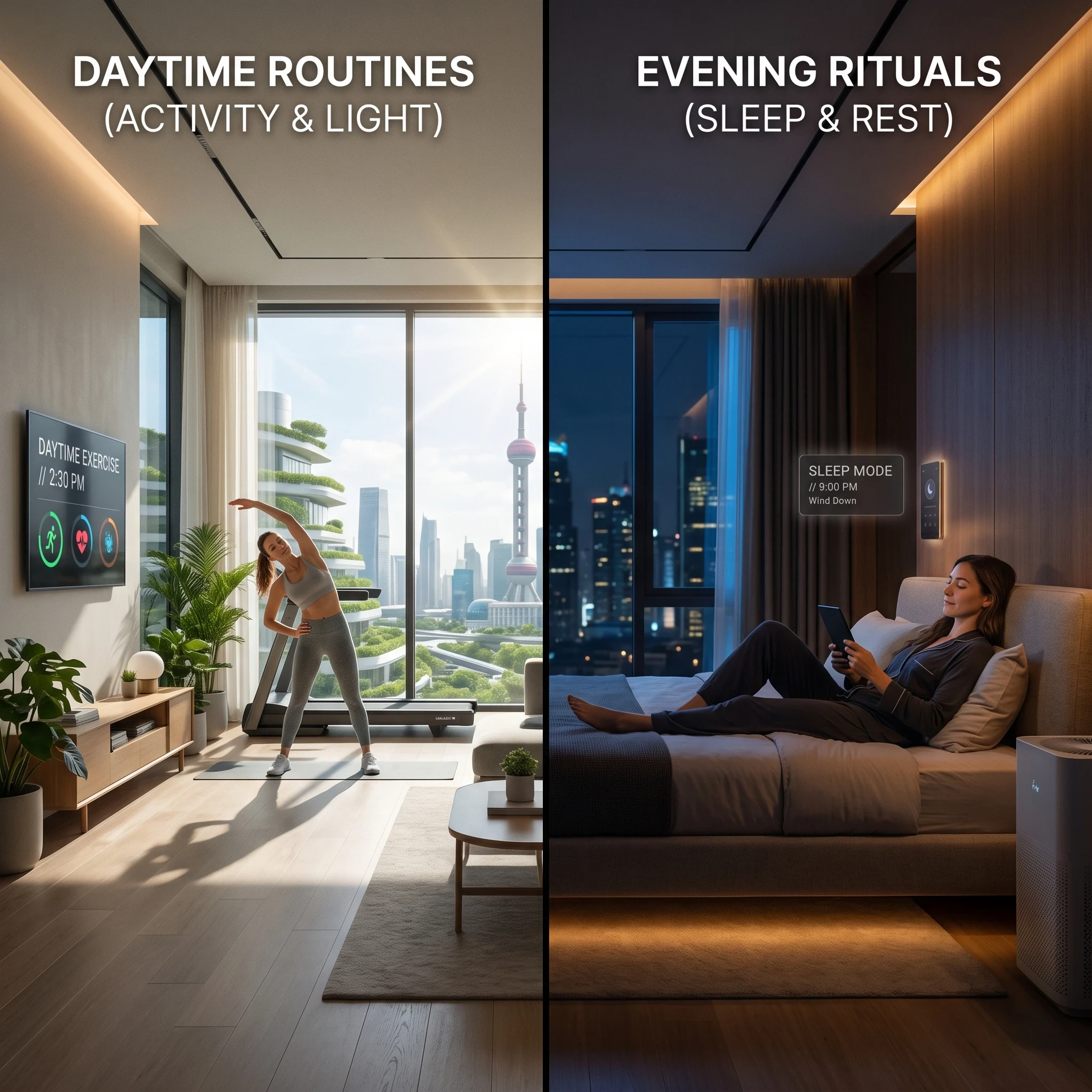
Healthy sleep isn’t shaped only by what happens immediately before bed.
Our bodies also respond to patterns and environmental cues throughout the day.
One of the most important of these is light.
Light and darkness help regulate circadian rhythms—the approximately 24-hour biological patterns involved in sleep and wakefulness.
Exposure to daylight, particularly earlier in the day, can help reinforce the body’s sleep-wake timing.
Consistency can matter too.
Going to bed and getting up at reasonably similar times from day to day can help support a more regular sleep schedule.
That doesn’t mean everyone needs to live according to an exact timetable.
Work, caring responsibilities, social commitments and ordinary life can all affect when we sleep.
The aim is consistency where it is realistically possible—not perfection.
Physical activity during the day can also support healthy sleep.
Current sleep guidance commonly includes regular exercise as part of healthy sleep habits, alongside sufficient sleep opportunity, appropriate light exposure and a supportive sleep environment.
So instead of thinking only about bedtime, it can be useful to look at the entire day:
Is your daily rhythm generally helping your body recognise when it’s time to be awake and when it’s time to prepare for sleep?
Even modest consistency can provide useful cues.
Further Reading
Practical guidance on healthy sleep habits, including regular sleep timing, physical activity and creating an appropriate bedroom environment.
Sleep Foundation — How To Fix Your Sleep Schedule
An overview of sleep timing, light exposure and other habits that can help support a consistent sleep-wake routine.
Learning Pathway
Continue your wellness journey with:
Building A Calmer Evening Routine For Sleep And Recovery
Later in this series, we’ll bring several of these principles into the hours leading towards bedtime.
Creating Small Recovery Moments During The Day
Recovery doesn’t always require finding an extra hour in an already busy schedule.
As we explored in Why Rest And Recovery Matter Alongside Nutrition, research describes wakeful rest and recovery in several ways, including periods of reduced activity, detachment from demands, relaxation and quieter experiences.
In ordinary life, this can translate into something quite simple:
creating moments when demands temporarily reduce.
That might look like:
- taking a short walk without simultaneously checking messages;
- allowing a few quiet minutes between demanding tasks;
- stepping outside and getting some daylight;
- eating a meal away from your workspace when circumstances allow;
- sitting quietly without immediately filling the pause with another task;
- spending time with someone whose company feels supportive;
- choosing gentle movement after spending a long period sitting.
None of these activities guarantees recovery.
And the same activity won’t feel restorative to everyone.
Their usefulness lies partly in giving us alternatives to moving continuously from one demand to another.
Think of these moments less as recovery techniques and more as opportunities for a little breathing room within the day.
Which one could realistically fit into tomorrow?
Not five.
Not an entirely redesigned routine.
Just one believable change.
That is often a more sustainable place to begin.
Learning Pathway
Continue your wellness journey with:
Simple Daily Habits That Support Nutrition And Brain Wellness
Explore another Dietremidies approach to building small, sustainable habits into everyday life.
Using Light To Support Your Sleep-Wake Rhythm
Light is one of the strongest environmental signals affecting circadian timing.
During the day, exposure to natural light helps reinforce wakefulness and the timing of the body’s internal clock.
At night, bright artificial light can send a different signal.
Research has shown that evening light can suppress melatonin and influence circadian timing, with shorter-wavelength blue light having particularly strong effects.
But this doesn’t mean every screen needs to become an enemy of healthy sleep.
The practical message is broader:
daytime light and nighttime darkness both matter.
Opening curtains after waking, spending some time outside during daylight hours and gradually reducing bright light as bedtime approaches can help create a clearer contrast between day and night.
If evening screen use regularly stretches later than intended, reducing it may also help create a calmer transition towards sleep.
The aim isn’t to become anxious about individual wavelengths of light.
It’s to give the body reasonably consistent environmental cues.
Further Reading
Harvard Health Publishing — Blue Light Has A Dark Side
Background on light, circadian rhythms, melatonin and why evening light exposure can influence sleep.
Creating A Sleep-Supportive Environment
Daily habits matter, but the bedroom itself also plays a role.
A sleep environment that is quiet, dark, relaxing and comfortably cool is consistently included in public-health guidance for healthy sleep.
The exact setup will differ from person to person.
Someone living beside a busy road will have different challenges from someone living in a quiet area.
Someone working shifts may need to create darkness during daylight hours.
And temperature preferences naturally vary.
So rather than trying to create a supposedly “perfect” bedroom, consider what can realistically be improved.
Could excess light be reduced?
Could unnecessary notifications be silenced?
Could the room be made quieter or more comfortable?
Could work-related devices be moved away from the bed where practical?
Small environmental changes can sometimes be easier to sustain than relying entirely on willpower at the end of a tiring day.
Ask yourself:
What does my bedroom currently encourage—winding down or staying alert?
The answer doesn’t have to produce an expensive bedroom makeover.
Sometimes one small change is enough to begin.
Paying Attention To Caffeine And Alcohol
What we consume can also influence sleep.
Caffeine
Caffeine promotes alertness, which is precisely why many people value it.
But its effects can persist for hours.
For people who are sensitive to caffeine, consuming coffee, tea, energy drinks or other caffeinated products later in the day can make it harder to fall asleep or sleep as well.
There isn’t one universal cut-off time that suits everyone.
Instead, if falling asleep is regularly difficult, it can be useful to notice how much caffeine you consume and how late in the day you consume it.
Alcohol
Alcohol presents a different issue.
It can initially cause drowsiness, which can make it appear helpful for sleep.
But alcohol can disrupt sleep as the night progresses and is associated with poorer sleep quality and more awakenings.
For that reason, using alcohol as a strategy for improving sleep isn’t recommended.
Again, this isn’t about creating rigid rules.
It’s about recognising that what happens several hours before bedtime can sometimes influence what happens after we get into bed.
Further Reading
CDC guidance includes limiting afternoon or evening caffeine and avoiding alcohol before bedtime as part of healthier sleep habits.
Let Movement Support Rather Than Complicate Recovery
Regular physical activity has broad health benefits and can also support healthy sleep.
But recovery isn’t about turning every available break into another workout.
Some days, a walk may feel restorative.
On others, sitting quietly may be what you need.
And someone who already has a physically demanding day may not need additional activity simply because movement appears on a wellness checklist.
This is where the wider principle from this series becomes useful:
consider the demands that came before the recovery opportunity.
Movement can be one part of a healthy daily rhythm without becoming another measure of whether you’ve had a “successful” day.
That distinction matters because sustainable wellbeing shouldn’t require us to optimise every hour.
One Habit Is Enough To Begin
By this point, it’s easy to look at the article and see a growing list:
consistent sleep timing;
daylight;
movement;
recovery pauses;
less evening stimulation;
a supportive bedroom;
attention to caffeine and alcohol.
Trying to change everything at once would defeat much of what this series is trying to accomplish.
Instead, ask:
Which change would make the greatest realistic difference to my current routine?
Perhaps your sleep timing varies considerably.
Perhaps caffeine has gradually moved later into the afternoon.
Perhaps your bedroom has become an extension of your workspace.
Perhaps the biggest issue isn’t bedtime at all—it’s that your day contains almost no genuine pauses.
Start there.
One realistic habit practised consistently is a more useful foundation than an ambitious routine that becomes impossible to maintain.
When Better Habits Aren’t Enough
Healthy sleep habits can support sleep, but they aren’t a treatment for every sleep problem.
If you regularly struggle to fall asleep or stay asleep, experience persistent daytime sleepiness or fatigue, or sleep difficulties are affecting concentration, mood, safety or everyday functioning, it’s appropriate to seek individual advice.
Sleep difficulties can have many causes, including medical conditions, medications, mental health concerns, circadian rhythm disorders and sleep disorders.
A GP or other appropriately qualified healthcare professional can consider your individual circumstances and determine whether further assessment or treatment is appropriate.
Everyday sleep habits can still form part of a healthy routine.
They simply shouldn’t be expected to solve every persistent sleep difficulty.
Looking Ahead
Supporting sleep and recovery rarely comes down to one dramatic change.
It can involve the rhythm of the day.
Exposure to light.
Movement.
Small opportunities for demands to reduce.
What we consume.
And the environment we return to when it’s time to sleep.
You don’t need to perfect all of them.
The purpose is to notice where your current routine could offer a little more support.
The next step is to bring several of these ideas into one particularly important transition:
the move from daytime demands towards nighttime rest.
That’s where this series turns next.
Continue Your Wellness Journey
Thank you for spending time with Dietremidies today.
Every resource within the Dietremidies Wellness Library is thoughtfully created to help you better understand the connections between stress, sleep, recovery and everyday wellbeing.
If today’s article has helped you think differently about everyday sleep and recovery habits, continue with:
Why Rest And Recovery Matter Alongside Nutrition
Revisit the broader recovery principles that provide the foundation for the habits explored here.
Building A Calmer Evening Routine For Sleep And Recovery
Continue into the next article in this series and explore how these ideas can come together during the transition towards bedtime.
A Gentle Reminder
Wellbeing isn’t built in a single day.
And healthy sleep isn’t determined by whether you follow every piece of sleep advice perfectly.
Some days your routine will feel naturally consistent.
Other days, work, family responsibilities, travel, illness or simply life will change the plan.
That’s normal.
Perhaps the most reassuring message is that supporting sleep and recovery doesn’t require rebuilding your entire life around sleep.
A little more consistency.
Some daylight.
A genuine pause during a demanding day.
A bedroom that feels slightly more restful.
An earlier final coffee if caffeine seems to be affecting you.
Small changes can become meaningful habits precisely because they’re realistic enough to repeat.
Choose what fits.
Pay attention to what helps.
And allow sustainable progress to matter more than perfection.
Thank you for allowing Dietremidies to be part of your wellness journey.
Whenever you’re ready, we’ll be here to welcome you to the next chapter of the Dietremidies Wellness Library.
Further Reading
Evidence-informed public-health guidance covering healthy sleep habits, sleep quality and when sleep difficulties may deserve further attention.
Sleep Foundation — Healthy Sleep Habits
A detailed overview of daytime and nighttime habits that can support healthier sleep.
Sleep Foundation — How To Fix Your Sleep Schedule
Guidance on consistent sleep timing, daylight, caffeine, alcohol and creating an appropriate sleep environment.
Harvard Health Publishing — Blue Light Has A Dark Side
Background on artificial light, circadian rhythms and the relationship between nighttime light exposure and sleep.
Disclaimer
The information provided in this article is intended for educational purposes only and should not replace personalised medical advice.
We strongly encourage you to consult a qualified healthcare professional before making significant decisions about your health, diet or wellbeing, particularly if you have an existing medical condition, take prescribed medication or have ongoing or concerning symptoms.
Affiliate Disclosure
Some Dietremidies articles contain carefully selected affiliate links. If you choose to purchase through one of these links, Dietremidies may receive a small commission at no additional cost to you.
Affiliate partnerships do not influence our commitment to providing balanced, educational wellness content.