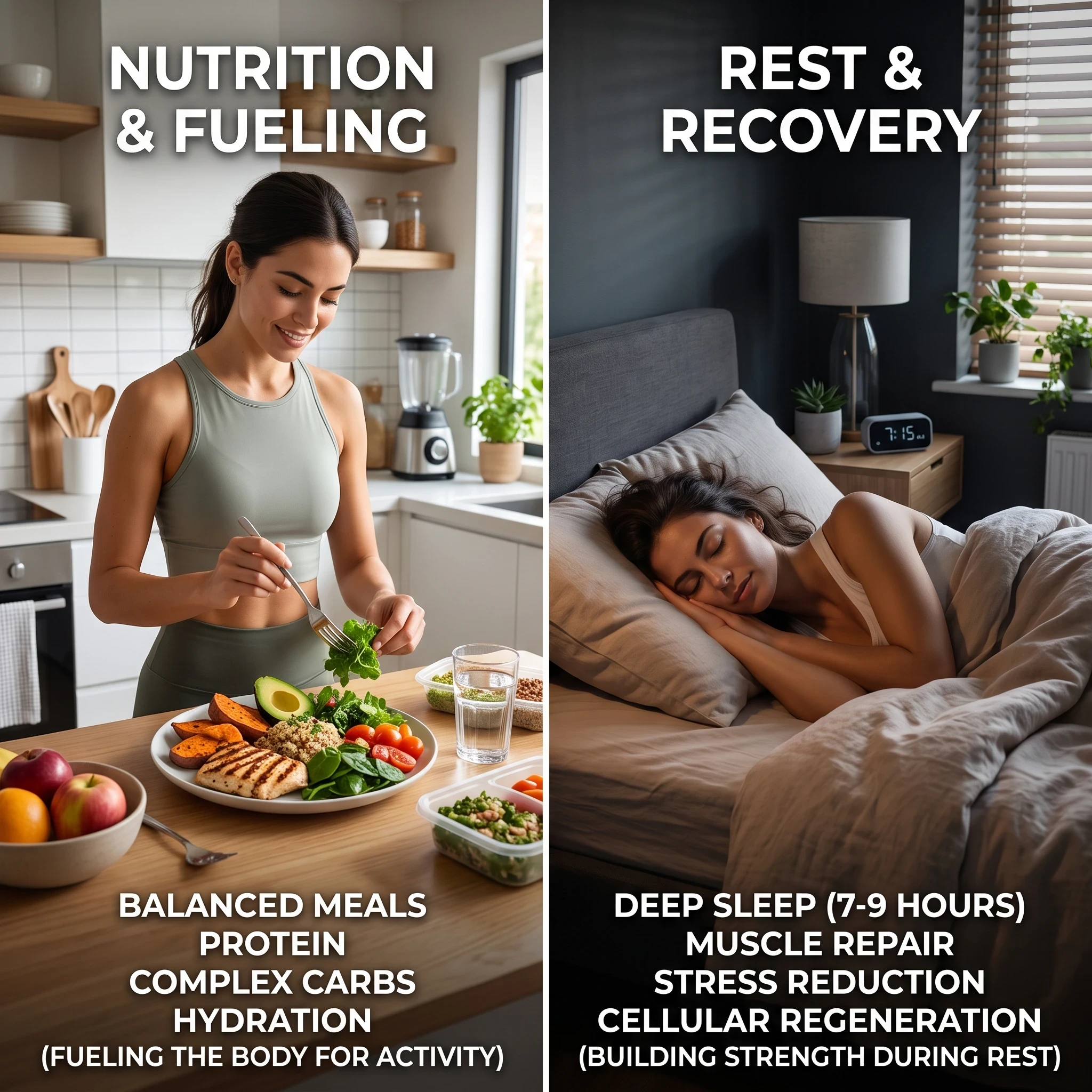
Nutrition tends to receive a great deal of attention in wellness conversations.
What to eat.
How to build a balanced plate.
How everyday food choices can support health and wellbeing.
These are important conversations, and they’re central to much of the Dietremidies Wellness Library.
But nourishment doesn’t exist in isolation.
The Connection Between Stress, Sleep And Recovery, earlier in this series, introduced recovery as something broader than sleep alone. It explored how periods of demand need to be balanced by opportunities for rest and recovery.
This article picks up that thread directly.
Not to argue that recovery matters more than nutrition—or to suggest that the two can be directly compared.
Instead, we’ll explore why nourishment, sleep and opportunities for recovery can all form part of a sustainable approach to everyday wellbeing.
What You’ll Discover
Throughout this article, you’ll explore what we mean by recovery beyond sleep and why opportunities to recover can sometimes receive less attention than more visible habits such as eating and exercise.
You’ll also discover why rest doesn’t always have to mean complete physical inactivity and how different forms of downtime can help create distance from different kinds of everyday demands.
Most importantly, we’ll begin shifting recovery from something that happens only when everything else is finished towards something worth considering as part of everyday wellbeing.
How This Article Can Help
By the end of this article, you’ll have a clearer way to think about rest and recovery without treating either as another wellness task that must be performed perfectly.
You’ll also be better prepared for the second half of this series, where we’ll move from understanding recovery towards practical ways of supporting sleep, rest and recovery within everyday routines.
What Do We Mean By Recovery?
Recovery is often associated with two things:
sleep and rest after physical activity.
Both can be important.
But neither captures the entire idea.
Within this Dietremidies series, we’re using recovery broadly to describe opportunities to rest, unwind and adapt following periods of physical, mental or emotional demand.
Sleep is one important part of this picture.
During sleep, the brain and body move through different stages associated with processes including memory, immune function, tissue repair, metabolism and emotional regulation.
But research into wakeful rest and recovery also points towards experiences that happen outside sleep.
A 2025 systematic scoping review found that research has described everyday wakeful rest in several ways, including stopping or reducing activity, temporarily detaching from activities, experiencing periods of peace or tranquillity, and having time for reflection or solitude.
Research into recovery from work similarly suggests that being able to mentally detach from demands and experience relaxation during non-work time can be relevant to recovery and wellbeing.
So recovery doesn’t have to mean doing absolutely nothing.
Sometimes it simply means creating periods in which the demands placed upon us reduce.
That leads to a useful reflection:
Is recovery something you make room for, or something that only happens when everything else is finished?
There is no correct answer.
But noticing the pattern can help us understand how much opportunity for genuine downtime our routines currently provide.
Further Reading
A 2025 systematic scoping review examining how wakeful rest has been defined and measured in everyday life.
Learning Pathway
Continue your wellness journey with:
Everyday Habits That Support Better Sleep And Recovery
Later in this series, we’ll turn these ideas into realistic everyday habits.
Why Recovery Can Be Easy To Overlook
Nutrition and exercise are relatively visible.
You can see a meal on a plate.
You can plan a walk or workout.
You can follow a recipe or prepare tomorrow’s lunch.
Recovery can be less obvious.
A quiet half-hour doesn’t produce the same visible result as preparing a colourful meal or completing a workout.
And modern routines can make downtime surprisingly easy to fill.
One task ends and another begins.
A workday finishes, but messages continue.
A quiet moment becomes an opportunity to check notifications, organise tomorrow or catch up on something that didn’t get finished earlier.
None of these behaviours automatically means someone isn’t recovering.
But they illustrate why opportunities to step away from demands can gradually become smaller without us necessarily noticing.
Research into recovery from work provides a useful example.
Psychological detachment—being mentally away from work during non-work time—has been studied as one aspect of recovery, alongside relaxation, having some control over leisure time and engaging in activities that provide a different kind of challenge or interest.
This research doesn’t give us a universal recipe for recovery.
It does, however, reinforce an important idea:
What we do outside demanding periods—and whether those demands continue occupying our attention—can matter.
That makes recovery something worth noticing rather than something we need to earn.
Learning Pathway
Continue your wellness journey with:
Simple Daily Habits That Support Nutrition And Brain Wellness
Explore how Dietremidies approached small, sustainable everyday habits within the Nutrition, Mood & Mental Clarity series.
Recovery Doesn’t Always Look The Same
One reason recovery can feel difficult to define is that rest isn’t one single experience.
Research doesn’t establish one universal list of “types of rest.”
Instead, studies describe several characteristics and experiences that can accompany recovery.
That distinction is useful because the kind of break that feels restorative can depend partly on the demands that came before it.
Physical Downtime
After a physically demanding period, recovery might involve sleep, sitting quietly or temporarily reducing physical demands.
But rest doesn’t always require complete stillness.
For some people and circumstances, gentle activity can also feel restorative.
The important distinction is that the activity isn’t simply adding another demanding task to an already demanding day.
Mental Detachment
Sometimes the body has stopped working while the mind hasn’t.
Thinking about unfinished tasks, repeatedly checking messages or mentally rehearsing tomorrow’s responsibilities can allow demands to continue occupying our attention.
Research into occupational recovery has therefore paid particular attention to psychological detachment—the experience of mentally stepping away from work during non-work time.
That doesn’t mean thoughts must disappear completely.
It simply reminds us that physical inactivity and mental downtime aren’t necessarily the same thing.
Quieter Periods
Wakeful rest research also includes experiences characterised by reduced activity, peace, tranquillity, solitude or reflection.
For someone whose day has involved constant conversation, screens, notifications or decision-making, a quieter period may provide a welcome contrast.
For someone whose day has been isolated, however, supportive social contact may feel more restorative than additional time alone.
This is why recovery doesn’t need a rigid formula.
A more useful question may be:
What has demanded the most from me today, and what would genuinely give me some distance from that demand?
Sometimes the answer will be sleep.
Sometimes it will be quiet.
Sometimes it may be movement, connection, relaxation or simply having a period when nothing urgent needs your attention.
The aim isn’t to diagnose a “rest deficit.”
It’s simply to become more aware of what recovery can look like in ordinary life.
Further Reading
Research identifying psychological detachment, relaxation, mastery and control as distinguishable experiences involved in recovery from work.
Learning Pathway
Continue your wellness journey with:
Building A Calmer Evening Routine For Sleep And Recovery
Later in this series, we’ll explore how quieter transitions and realistic recovery opportunities can fit into an everyday evening routine.
Where Nutrition Fits Into The Recovery Picture
If this article is about recovery, why keep nutrition in the conversation?
Because the purpose isn’t to replace one wellness priority with another.
Nutrition provides the body with energy and essential nutrients.
Sleep supports biological processes throughout the brain and body.
Periods of reduced demand can create opportunities to rest and unwind.
Movement has its own important role in health.
These aren’t competing strategies.
They’re different parts of a wider wellbeing picture.
This is also why the title of this article uses the word alongside.
There isn’t a meaningful scientific formula that tells us recovery is “equally important” to nutrition.
Their roles are different, and individual needs vary.
A more useful principle is that focusing intensely on one aspect of wellbeing doesn’t make the others irrelevant.
Someone can eat a balanced diet and still have a demanding schedule.
Someone can exercise regularly and still struggle to find meaningful downtime.
Someone can prioritise sleep while spending most waking hours moving rapidly between responsibilities.
Wellbeing rarely rests on one behaviour alone.
For Dietremidies, this matters because healthy eating should support everyday life—not become another reason to pursue perfection.
Nourishment and recovery can sit alongside one another as parts of a more sustainable approach.
Recovery Is Not Another Standard To Perfect
Once we begin talking about recovery, there’s a risk of turning it into another target:
Did I rest enough?
Did I recover properly?
Should I be doing more to relax?
That isn’t the purpose of this article.
Recovery doesn’t need to become another performance measure.
Some days naturally contain more demands than others.
Some periods of life leave more space for rest.
Others leave considerably less.
The useful shift isn’t from not recovering correctly to recovering perfectly.
It’s from rarely noticing recovery at all to occasionally asking:
Where are the opportunities for demands to reduce in my day?
Sometimes even recognising that those opportunities have become scarce can tell us something useful about our current routine.
When Tiredness Deserves More Attention
Feeling tired after a demanding day or occasionally needing additional rest is part of ordinary life.
Persistent exhaustion is different.
If you’re regularly getting adequate opportunities for sleep and rest but still feel unusually exhausted, if tiredness is significantly affecting everyday functioning, or if changes in energy are persistent or concerning, general wellness advice shouldn’t be used to explain the cause.
Fatigue can have many possible contributors, including health conditions, medications, sleep problems and mental health concerns.
A GP or other appropriately qualified healthcare professional can assess individual circumstances and determine whether further investigation or support is appropriate.
Similarly, persistent low mood, loss of interest or difficulty coping deserves appropriate professional support rather than being interpreted simply as evidence that someone needs “more recovery.”
Everyday wellbeing strategies and professional healthcare can work alongside one another.
Looking Ahead
Recovery isn’t simply the passive leftover of a day spent thinking about nutrition, exercise and responsibilities.
It represents opportunities for demands to reduce and for rest, sleep and downtime to have a place within everyday life.
And recovery doesn’t always look the same.
Sometimes we need physical rest.
Sometimes we need distance from mentally demanding tasks.
Sometimes a quieter period helps.
At other times, supportive connection or gentle activity may feel more restorative.
Understanding that flexibility is useful.
Putting it into practice is where this series turns next.
What might it look like to build realistic opportunities for recovery into an ordinary day—without creating another complicated wellness routine?
That’s the question we’ll explore next.
Continue Your Wellness Journey
Thank you for spending time with Dietremidies today.
Every resource within the Dietremidies Wellness Library is thoughtfully created to help you better understand the connections between stress, sleep, recovery, nutrition and everyday wellbeing.
If today’s article has helped broaden your understanding of recovery, continue with:
The Connection Between Stress, Sleep And Recovery
Revisit how recovery fits into the wider relationship between everyday demands, stress and sleep.
Everyday Habits That Support Better Sleep And Recovery
Continue into the practical half of this series and explore realistic ways to create more opportunities for sleep and recovery within everyday life.
A Gentle Reminder
Wellbeing isn’t built in a single day.
And rest doesn’t need to become something else you have to perform perfectly.
Some days will naturally offer more opportunities for recovery than others.
Sometimes recovery will mean sleep.
Sometimes it might mean stepping away from a demanding task, enjoying a quieter period, going for a gentle walk or spending time with someone whose company feels supportive.
Perhaps the most reassuring message is that recovery doesn’t have to compete with nutrition, movement or the other parts of wellbeing.
It can sit alongside them.
You don’t need a perfect recovery routine to begin paying attention to the balance between demands and downtime.
Small, sustainable opportunities to rest and unwind can become part of everyday life without requiring a dramatic reset.
Be patient with yourself.
Continue learning with curiosity.
And allow sustainable progress to matter more than perfection.
Thank you for allowing Dietremidies to be part of your wellness journey.
Whenever you’re ready, we’ll be here to welcome you to the next chapter of the Dietremidies Wellness Library.
Further Reading
A systematic scoping review examining how wakeful rest has been defined and measured in research.
Research examining psychological detachment, relaxation, mastery and control as recovery experiences during leisure time after work.
Sleep Foundation — What Happens When You Sleep?
A medically reviewed explanation of sleep stages and the processes occurring in the brain and body during sleep.
American Psychological Association — Stress Effects On The Body
An overview of how short-term and chronic stress can affect different systems throughout the body.
Disclaimer
The information provided in this article is intended for educational purposes only and should not replace personalised medical advice.
We strongly encourage you to consult a qualified healthcare professional before making significant decisions about your health, diet or wellbeing, particularly if you have an existing medical condition, take prescribed medication or have ongoing or concerning symptoms.
Affiliate Disclosure
Some Dietremidies articles contain carefully selected affiliate links. If you choose to purchase through one of these links, Dietremidies may receive a small commission at no additional cost to you.
Affiliate partnerships do not influence our commitment to providing balanced, educational wellness content.