
Not all body fat is the same. Two people can have a similar body weight and outward appearance while carrying very different proportions of visceral and subcutaneous fat. Understanding that distinction helps explain why where fat is stored can matter alongside how much body fat a person carries overall.
Subcutaneous fat is stored directly beneath the skin and is the type of fat you can usually pinch around areas such as the abdomen, hips, thighs, and upper arms. Visceral fat sits much deeper within the abdominal cavity, surrounding internal organs including the liver and intestines.
That difference in location isn’t simply anatomical. These two forms of fat differ in how they store and release energy, how metabolically active they are, and how strongly they are associated with different aspects of health.
This article focuses specifically on what distinguishes visceral fat from subcutaneous fat, building on the wider health implications discussed in Why Visceral Fat Matters For Overall Health rather than repeating them here.
What You’ll Discover
Throughout this article, you’ll learn where visceral and subcutaneous fat are stored, how their biological roles differ, why their metabolic behaviour isn’t identical, and what these differences mean when thinking about body composition and overall health.
You’ll also discover why body weight or appearance alone cannot tell the complete story of how fat is distributed throughout the body.
How This Article Can Help
By the end of this article, you’ll have a clearer understanding of why body fat shouldn’t be viewed as one single type of tissue and why fat distribution provides information that the number on a scale cannot offer by itself.
More importantly, you’ll be encouraged to think about body composition with greater perspective, focusing less on appearance alone and more on the wider factors that contribute to long-term metabolic wellbeing.
Where Visceral And Subcutaneous Fat Are Stored
The easiest way to understand the distinction is to begin with location.
Subcutaneous fat sits directly beneath the skin. It is distributed throughout the body and commonly accumulates around areas such as the hips, thighs, abdomen, buttocks, and upper arms.
Visceral fat, by comparison, is stored deeper within the abdominal cavity around internal organs. Because it cannot simply be seen or pinched from the outside, appearance alone does not provide a reliable indication of how much visceral fat someone carries.
This helps explain why two people with similar body weights or outward appearances can still have different patterns of body-fat distribution.
Research has increasingly recognised this distinction as important because fat distribution, particularly the accumulation of visceral adipose tissue, provides information about metabolic health that overall body size alone cannot fully capture.
The distinction also matters because location influences how these fat tissues interact with the rest of the body.
Visceral And Subcutaneous Fat At A Glance
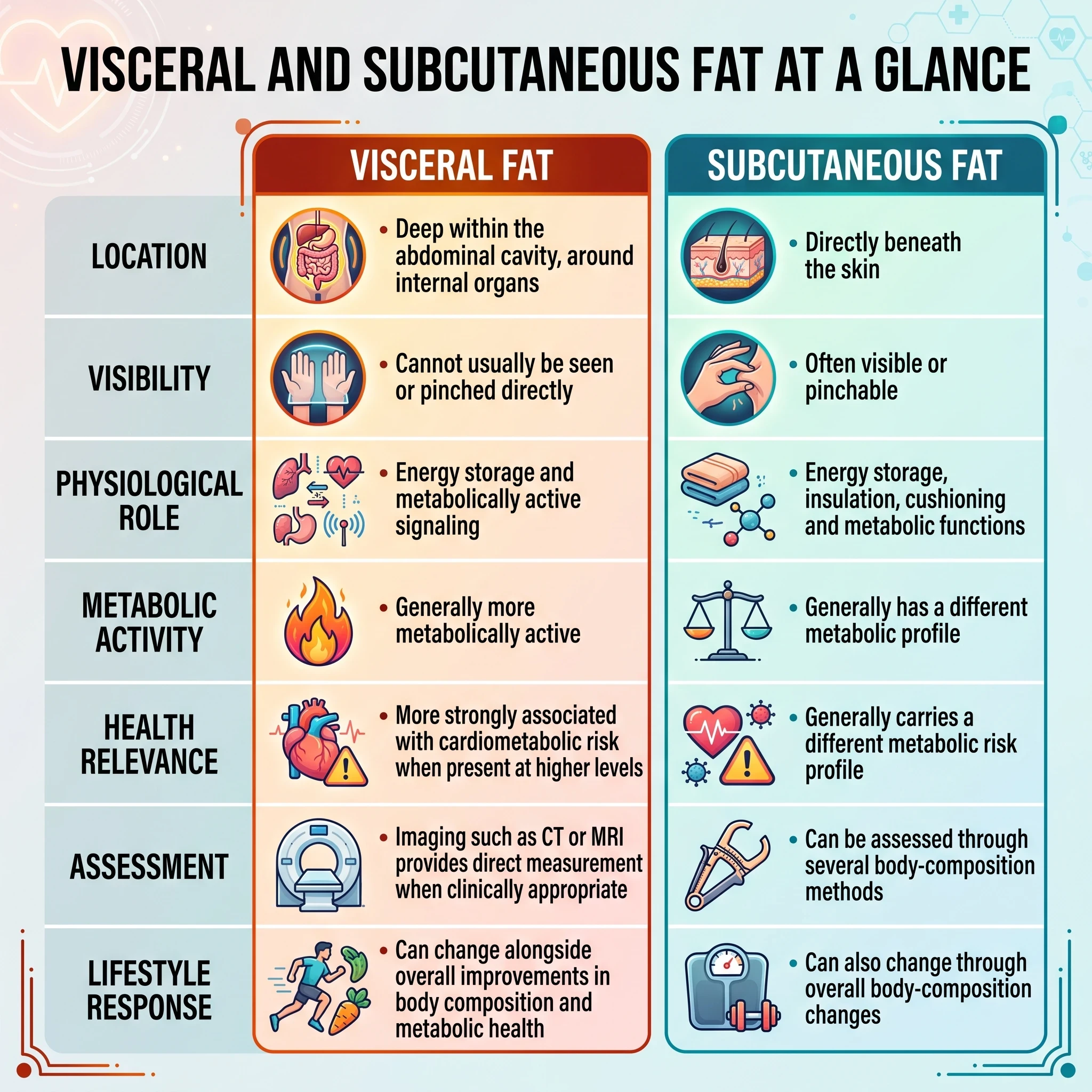
The important point isn’t that one form of body fat is simply “good” and the other “bad.” Both are forms of adipose tissue, and body fat performs necessary biological functions. What differs is their location, behaviour, and relationship with other processes throughout the body.
Why These Two Types Of Fat Behave Differently
Body fat isn’t simply an inactive storage space for excess energy. Adipose tissue participates in a range of biological processes, and visceral and subcutaneous fat don’t behave identically.
Visceral fat is generally more metabolically active and has higher lipolytic activity, meaning stored fatty acids can be released more readily. Because much of the blood draining visceral tissue reaches the liver through the portal circulation, researchers have investigated whether this contributes to some of the metabolic differences associated with visceral fat.
This explanation is sometimes described as the portal hypothesis. However, the relationship is more complex than any single mechanism, with inflammatory signalling, hormones, genetics, overall body composition, and lifestyle all contributing to metabolic health.
Research continues to distinguish visceral adipose tissue from other fat stores because of its metabolic activity and its stronger association with systemic metabolic dysfunction.
Research Reference:
Global Patterns Of Visceral Adiposity And Cardiometabolic Disease — Nature Reviews Endocrinology
Subcutaneous fat performs important physiological functions of its own. It stores energy, provides insulation, helps protect underlying tissues, and contributes to normal metabolic and hormonal processes.
This distinction is important because body fat itself isn’t simply something the body needs to eliminate. Fat tissue performs necessary biological functions. The amount, location, distribution, and metabolic characteristics of that tissue all contribute to the wider health picture.
Why Fat Distribution Matters
The distinction between visceral and subcutaneous fat becomes particularly important when considering metabolic health.
Higher levels of visceral fat are more strongly associated with insulin resistance, cardiovascular disease, type 2 diabetes, and broader metabolic dysfunction than subcutaneous fat alone.
Research examining body-fat distribution has shown why this distinction matters. Visceral adiposity is now recognised as a particularly important fat depot because of its strong association with systemic metabolic dysfunction. This also helps explain why measurements concerned with abdominal fat distribution can provide information that body weight or BMI alone cannot fully capture.
The wider health implications of visceral fat are explored more fully in Why Visceral Fat Matters For Overall Health, allowing us to continue the learning journey without repeating that discussion here.
Subcutaneous fat generally carries a different metabolic risk profile, although overall body-fat levels, distribution, genetics, fitness, existing health conditions, and other individual factors still matter.
This is why body weight alone provides only limited information.
Two people can weigh the same while having different proportions of muscle, visceral fat, and subcutaneous fat. Likewise, changes on the scale don’t necessarily reveal exactly which tissues have changed.
Understanding body composition therefore provides a more nuanced perspective than categorising someone’s health according to body weight or appearance alone.
For readers who would like a straightforward explanation of these differences, Harvard Health also provides an accessible overview of abdominal fat and why visceral fat deserves particular attention.
Reader-Friendly Reference:
Abdominal Fat And What To Do About It — Harvard Health
➜ Learning Pathways
Continue your wellness journey with:
➜ Why Visceral Fat Matters For Overall Health – Explore why visceral fat deserves particular attention within metabolic health and how its location and biological activity distinguish it from fat stored beneath the skin.
Understanding How Body Fat Changes
Another useful distinction involves how these fat stores respond when overall body composition changes.
Visceral and subcutaneous fat can both change alongside sustainable improvements in physical activity, nutrition, sleep, and other lifestyle factors. Regular aerobic movement and strength-based activity can form part of a broader approach to supporting metabolic health and healthier body composition.
The rate and location of visible changes can differ considerably between individuals.
Genetics, hormones, age, sex, starting body composition, energy balance, and lifestyle all influence where the body stores fat and where changes become noticeable first.
This is why targeted exercises don’t reliably remove fat from one chosen area of the body. Abdominal exercises, for example, can strengthen abdominal muscles, but they don’t instruct the body to use fat specifically from the abdomen.
This principle is explored further in Why Belly Fat Can Be Difficult To Lose, where the wider influences on abdominal fat storage are discussed in more detail.
The practical message is therefore much simpler than trying to design separate routines for visceral and subcutaneous fat: supporting overall health and body composition provides a more realistic approach than attempting to control one individual fat store.
Looking Ahead
As you’ve discovered throughout this article, visceral and subcutaneous fat differ in their location, biological behaviour, metabolic activity, and relationship with health.
Understanding those differences helps move the conversation beyond appearance or the number on a scale.
Rather than trying to identify or target one type of fat yourself, consider the broader habits that support metabolic wellbeing, including regular movement, balanced nutrition, restorative sleep, stress management, and appropriate professional healthcare when needed.
Perhaps the most reassuring message to take from this article is that understanding body fat doesn’t have to lead to greater judgement of your body.
It can instead provide a clearer understanding of how complex the body really is and why sustainable health is about far more than appearance alone.
Every walk, every strength session, every balanced meal, and every restful night contributes to the broader foundation that supports your health over time.
Progress isn’t measured by perfection.
It is measured by your willingness to keep learning, keep adjusting, and keep supporting your body, one thoughtful choice at a time.
Continue Your Wellness Journey
Thank you for spending time with Dietremidies today.
Every resource within the Dietremidies Wellness Library has been thoughtfully created to help you better understand the connections between nutrition, lifestyle, body composition, and long-term health.
If today’s article has helped you understand the difference between visceral and subcutaneous fat, I invite you to continue exploring the Wellness Library, where each resource has been selected to broaden your understanding while avoiding unnecessary repetition of what you’ve already learned.
A Gentle Reminder
Wellbeing isn’t built in a single day.
It grows through the choices you make each day.
Some days you’ll feel motivated.
Some days you need to slow down.
Both are part of the journey.
Be patient with yourself.
Celebrate the small victories.
Continue learning with curiosity.
And remember that meaningful progress comes from consistent, thoughtful habits rather than striving for perfection.
Thank you for allowing Dietremidies to be part of your wellness journey.
Whenever you’re ready, we’ll be here to welcome you to the next chapter of the Dietremidies Wellness Library.
Disclaimer
The information provided in this article is intended for educational purposes only and should not replace personalised medical advice. We strongly encourage you to consult a qualified healthcare professional before making significant decisions about your health, diet, or wellbeing, particularly if you have an existing medical condition, take prescribed medication, or have ongoing health concerns.
Affiliate Disclosure
Some Dietremidies articles contain carefully selected affiliate links. If you choose to purchase through one of these links, Dietremidies may receive a small commission at no additional cost to you. Affiliate partnerships do not influence our commitment to providing balanced, educational wellness content.